Home › Posts filed under MOBILE TECHNOLOGY
Showing posts with label MOBILE TECHNOLOGY. Show all posts
Future of Cell Phones
This mobile phone is completely flexible due to the technology behind it… it uses a graphene touch screne being graphene based makes it essentially indestrucable the battery has been created by NEC which is an organic radical secondary battery it’s slim, felxible and has a high-speed charge which is it’s key feature of only taking 30 seconds to mantain a full charge. the phone is also waterproof and the main speaker and keyboard can be removed for ease of use.
RollerPhone Bracelet
At first sight this rollerphone bracelet looks like a watch telling time in a more fashionable and futuristic way that projects time on your wrist. But it is actually a cellphone with a retractable transparent screen at the base reflecting perfect ergonomics and design. You can roll out the touch screen to the tips of your fingers delivering a proper position in between your mouth and ear. This rollerphone has a media center in itself like you can watch videos, play games, chat online, read e-books and listen to your music just on your wrist. I think this rollerphone will definitely spice up your entire digital world with its extraordinary specs and features.
The Blackberry Torch 9800 full specification and new features
BlackBerry Torch has a 11.1 cm high in a closed state. If the sliding Qwerty keyboard is opened,
the high reached 14.8 cm. In terms of width, this device has a width of 6.2 cm.
Were pretty good thick at 1.46 cm.
Blckberry torch use screen HVGA 3.2 inch with a resolution of 480×360.
Presumably this will be different screen technology with the BlackBerry Storm
which uses SurePress technology, which is sometimes dubbed as ’shaking screen’.
Memory is provided for Torch is 512 MB SDRAM, 4GB microSD eMMC and could add up to 32 GB.
While the processor has a clock of 624 MHz.
Blackberry torch full specification:
General 2G Network GSM 850 / 900 / 1800 / 1900
3G Network UMTS 850 / 1900 / 2100 /800
Announced 2010, August
Size Dimensions 111 x 62 x 14.6 mm
Weight 161 g
Camera & Video Recording- 5 MP camera
- Continuous auto-focus
- Image stabilization
- Flash
- 11 scene modes
- 2X digital zoom
- VGA (640×480) video recording
- Geotagging
Memory - 512 MB flash memory / 512 MB SDRAM
support for microSD card up to 32 GB
Display- Type-TFT touchscreen
Size 360 x 480 pixels, 3.2 inches
- QWERTY keyboard
- Optical trackpad
- Proximity sensor for auto turn-off
Data GPRS Class 10 (4+1/3+2 slots), 32 – 48 kbps
EDGE Class 10, 236.8 kbps
3G Yes, 384 kbps
WLAN Wi-Fi 802.11 b/g/n, UMA (carrier-dependent)
Bluetooth Yes, v2.1 with A2DP
Infrared port No
USB Yes, microUSB v2.0
Battery & Battery Life
- 1300 mAHr removable/rechargeable lithium-ion cell
- Standby Time: GSM® – up to 18 days, UMTS – up to 14 days
- Talk Time: GSM – up to 5.5 hours, UMTS – up to 5.8 hours
- Music Playback: up to 30 hours
- Video Playback: up to 6 hours
Features
- Optical trackpad
- High-resolution touch screen
- Full QWERTY keyboard
- 3G network support
- Simultaneous voice and data
- Email and text messaging
- BlackBerry® Messenger
- Instant Messaging
- Phone
- Browser
- Social feeds
- Camera and video recording
- Wi-Fi®
- GPS
- Media player
- Organizer
- Bluetooth®
- Tethered modem
KT Corporation WiBro Network, Seoul, South Korea
KT Corporation is one of Korea’s leading telecommunications companies, which provides services to residential and business users across South Korea.
The company offers fixed-line telephone services, business and data communication services including broadband internet access and leased-line, mobile services through KT, one of its subsidiaries (previously KT Free tel), which is the second largest mobile provider.
Other telecommunications services provided include system and network integration, as well as satellite communications. The corporation owns two satellites, all of South Korea’s domestic public exchanges, the complete network of local telephone lines, public long-distance telephone transmission facilities and the primary data communications network in the country.
The latest innovation the company has introduced is mobile WiMAX coverage; the company started a trial of the technology across Seoul in the first quarter of 2006.
WiBro got off the ground at some high-demand areas in Seoul and the city’s outskirts, including Sinchon, Gangnam-gu, Seocho-gu, Songpa-gu, Bundang and along the Bundang subway line.
Although the trial service has attracted few users (less than 1,000 due to lack of access devices) in April 2007 they decided to expand the network to cover the whole of the city.
Nokia -The Morph Concept Phone
The Morph Concept Phone-Nokia
Another innovative design concept from Nokia, the morph concept. Featured in The Museum of Modern Art ?Design and The Elastic Mind? exhibition, the Morph concept device is a bridge between highly advanced technologies and their potential benefits to end-users. Developed by NRC (Nokia Research Center) in collaboration with the Cambridge Nanoscience Centre (United Kingdom), Morph is a concept phone that using nanotechnology which enables materials and components that are flexible, stretchable, transparent and remarkably strong. Users should be able to transform their cell phone into different shapes.
Nokia Concept The Morph Phone
Morph concept technologies might create fantastic opportunities for mobile devices: * Newly-enabled flexible and transparent materials blend more seamlessly with the way we live* Devices become self-cleaning and self-preserving
* Transparent electronics offering an entirely new aesthetic dimension
* Built-in solar absorption might charge a device, whilst batteries become smaller, longer lasting and faster to charge
* Integrated sensors might allow us to learn more about the environment around us, empowering us to make better choices”
We probably see this technology another 5-7 years in the future, by using nanotechnology, hopefully can lead to low cost manufacturing solutions and the possibility of integrating complex functionality at a low price.
New And Latest Nokia Design
Please say Thanks If You Like My Post
Android, Windows Phone 7 undefeated Hacking competition Leaves
It took only two days for hackers to crack into the Apple and Blackberry operating systems during the three-day Pwn2Own tournament last week, while Android and Windows Phone 7 models were abandoned and left unhacked by the end of the contest.
Is this because their operating systems are more secure? Yes and no.
"The survival of a target at Pwn2Own does not automatically declare it safer than a target that went down," last year's Internet Explorer Pwn2Own winner Peter Vreugdenhil cautions. The contestants who were lined up to beat the Android and WP7 devices in the competition withdrew for a variety of reasons.
now in its fifth year, is a hacking competition divided into two areas: web browsers and mobile phones.
This year, Microsoft Internet Explorer 8, Apple Safari 5.0.3, Mozilla Firefox, and Google Chrome were the web-browser targets. In the mobile phone category, the Dell Venue Pro (Windows Phone 7), Apple iPhone 4 (iOS), BlackBerry Torch 9800 (Blackberry 6) and Nexus S (Android) were targeted.
The OS and browser versions were frozen last week (so for example, Apple's Safari 5.0.4 update was not used), ensuring that all contestants are working on the same version of each OS.
Pwning and owning occurs if the hacker defeats the frozen version. If the exploit they used still exists in the current firmware, they are also eligible to receive a monetary prize. The 2011 Pwn2Own competition ran March 9 to 11.
Vreugdenhil says many different factors determine how hard a target is to hack. There's the safety of the software itself, the exploit mitigations that are already in place for that software, and then the amount of research that has already been conducted (which can speed up the process of writing an actual exploit).
Firefox and Chrome web browsers were also left undefeated because contestants withdrew from Pwn2Own.
"Chrome has the advantages of having multiple exploit-mitigation techniques that certainly make it more difficult to hack. As for Android, we see no particular reason why Android would be harder to hack than one of the other targets."
Safari, Chrome, iPhone, Android and Blackberry all use WebKit in their browsers, which means that they are all susceptible to exploitation through the browser -- and that's exactly how the iPhone and Blackberry were attacked.
Charlie Miller, a Pwn2Own veteran, worked with Dion Blazakis to hack the iPhone 4 in this year's competition using a flaw in its Mobile Safari Web browser and a "specially-crafted webpage." A team of 3 (Vincenzo Iozzo, Willem Pinckaers, and Ralf Philipp Weinmenn) defeated the BlackBerry Torch using a similar technique.
So what did the contest's organizers think of the outcome of 2011's Pwn2Own?
Vreugdenhil and other organizers were not surprised that the iPhone went down quickly. It has been a major target and a lot of research has already been done on that platform.
Android's survival was a bit of a surprise, since it is also a big target and had four contestants lined up.
Although no device is unhackable, some factors contribute to a safer product. For those that are out to find the safest phone on the market, Vreugdenhil says you'll want to compare features such as DEP (Data Execution Prevention), ASLR (address space layout randomization), Sandboxing, code signing and the ease with which software can be updated on the device.
Is this because their operating systems are more secure? Yes and no.
"The survival of a target at Pwn2Own does not automatically declare it safer than a target that went down," last year's Internet Explorer Pwn2Own winner Peter Vreugdenhil cautions. The contestants who were lined up to beat the Android and WP7 devices in the competition withdrew for a variety of reasons.
now in its fifth year, is a hacking competition divided into two areas: web browsers and mobile phones.
This year, Microsoft Internet Explorer 8, Apple Safari 5.0.3, Mozilla Firefox, and Google Chrome were the web-browser targets. In the mobile phone category, the Dell Venue Pro (Windows Phone 7), Apple iPhone 4 (iOS), BlackBerry Torch 9800 (Blackberry 6) and Nexus S (Android) were targeted.
The OS and browser versions were frozen last week (so for example, Apple's Safari 5.0.4 update was not used), ensuring that all contestants are working on the same version of each OS.
Pwning and owning occurs if the hacker defeats the frozen version. If the exploit they used still exists in the current firmware, they are also eligible to receive a monetary prize. The 2011 Pwn2Own competition ran March 9 to 11.
Vreugdenhil says many different factors determine how hard a target is to hack. There's the safety of the software itself, the exploit mitigations that are already in place for that software, and then the amount of research that has already been conducted (which can speed up the process of writing an actual exploit).
Firefox and Chrome web browsers were also left undefeated because contestants withdrew from Pwn2Own.
"Chrome has the advantages of having multiple exploit-mitigation techniques that certainly make it more difficult to hack. As for Android, we see no particular reason why Android would be harder to hack than one of the other targets."
Safari, Chrome, iPhone, Android and Blackberry all use WebKit in their browsers, which means that they are all susceptible to exploitation through the browser -- and that's exactly how the iPhone and Blackberry were attacked.
Charlie Miller, a Pwn2Own veteran, worked with Dion Blazakis to hack the iPhone 4 in this year's competition using a flaw in its Mobile Safari Web browser and a "specially-crafted webpage." A team of 3 (Vincenzo Iozzo, Willem Pinckaers, and Ralf Philipp Weinmenn) defeated the BlackBerry Torch using a similar technique.
So what did the contest's organizers think of the outcome of 2011's Pwn2Own?
Vreugdenhil and other organizers were not surprised that the iPhone went down quickly. It has been a major target and a lot of research has already been done on that platform.
Android's survival was a bit of a surprise, since it is also a big target and had four contestants lined up.
Although no device is unhackable, some factors contribute to a safer product. For those that are out to find the safest phone on the market, Vreugdenhil says you'll want to compare features such as DEP (Data Execution Prevention), ASLR (address space layout randomization), Sandboxing, code signing and the ease with which software can be updated on the device.
Category ›
MOBILE TECHNOLOGY
,
TECHNOLOGY
Nokia 2030 Cellphone Concept
Here’s the Nokia cellphone concept of 2030 in case you wanted a taste of the future… Created by Jim Chan, the Nokia 2030 features a scratch-resistant finished body, plus a full color display and an illuminated touch keypad.
Fast messaging is the purpose of this unit and we learn that the phone measures 2 x 4.75 x 0.25 inches and attaches colored films at the rear, to change its color. Polished titanium is the choice of metal for the case area that protects the screen. This handset looks like some sort of futuristic keycard that grants access to a high tech facility and we bet it’ll have e-wallet features and a transparent UI.
Kinetic Cellphone Concept for Nokia
Nokia Kinetic Cell Phone Concept

British designerJeremy Hopkins took cellphones to a new level and created unique concept of the phone. His phone called Nokia Kinetic converts digital information into kinetic energy and make receiving a call, text message of email more visual. It has an electromagnet at the base which allow to shift the weight and keep it in an upright position. User checks the screen of the phone and if he wants to miss a call he should simply give a phone a tap, causing the phone to fall back down again and return back to standby mode. "Aimed at the business user, Nokia Kinetic is an unique phone that responds to notifications trough movement".

Weather Phone
Weather cell Phone
The Windows Weather Phone is a refresh from bad weather predictions and inconvenient phone interfaces. The Windows Weather Phone is not only able to predict weather accurately, but also make its completely transparent body mimic the weather. If it’s snowing outside, it would appear as if it’s realistically snowing inside the phone itself- creating an astounding illusion.
The Windows Weather Phone uses OLED technology- this allows its transparency without sacrificing technological power. Much like other phones, this phone is able to perform a variety of features such as calling, texting, videos, music and others. Additional to these features, its transparency allows it to perform a unique feature- it can completely mimic weather outside. On a rainy day, the phone would appear to be filled with raindrops, while on a sunny day the phone would appear bright. Although not a particularly useful feature, it’s enjoyable to experiment around with. The Weather Phone also contains text recognition software. To initiate text recognition simply blow onto the screen- the phone recognizes the change in air pressure and responds.
The Windows Weather Phone has no buttons- all functions are controlled through the touch screen. It also allows interaction with the actual weather- for example it allows writing and drawing on a foggy screen- much like how you would draw on a misty window. Although not planned to be commercially sold soon, its sleek design and unique features promises a bright future.
Text Message Mode
Call Mode
Category ›
latest weather phone
,
MOBILE TECHNOLOGY
,
TECHNOLOGY
,
weather cell phone
,
weather phone
Flex Cellphone the “Touchscreen Click”.
Flex Cellphone
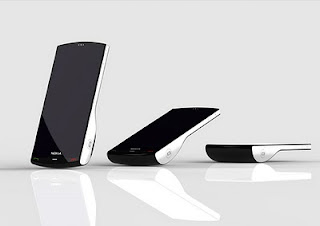
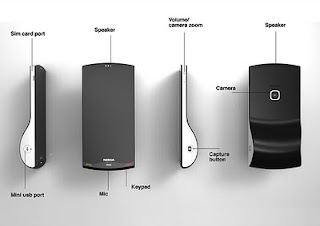
Ever wanted to combine the touchscreen experience with the feeling of pressing a genuine physical button? Valentin Neda has the next best thing, through a phone design called Flex Click, a cellphone that provides tactile feedback while pressing touch buttons on the screen.
Micro switches are placed under the curved Soft Touch display and they’ll reduce the stress on the user’s fingers, for an unique touch experience. These switches can be pressed in the spot where one expects to find a real button or control and they also depend on the displayed content, as the concept’s creator claims.
Is it just me or is there something screaming Black Berry and Web OS about this device?
Category ›
latest cellphone
,
latest touch screen cellphone
,
MOBILE TECHNOLOGY
,
TECHNOLOGY
,
touch screen mobile
Subscribe to:
Posts (Atom)